Who
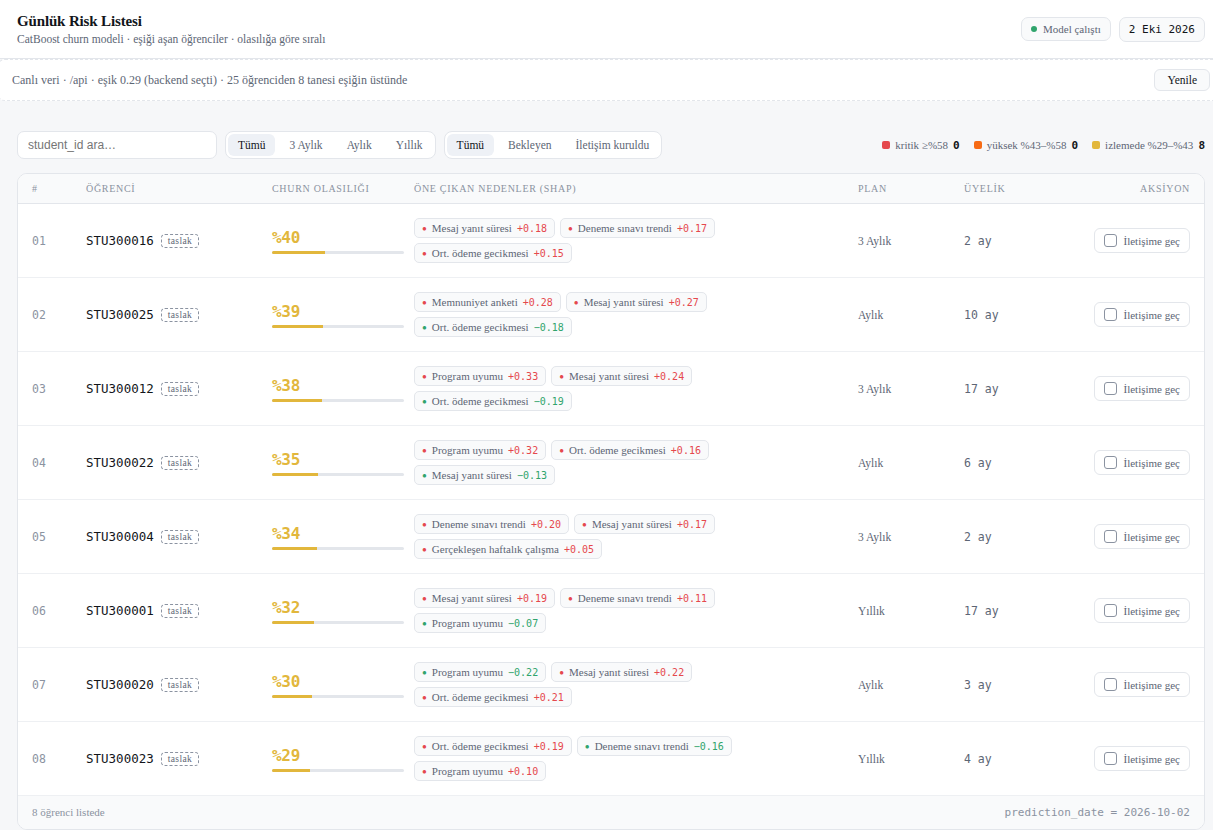
A calibrated dropout probability for every active student, ranked by risk. Not a binary “at risk / not at risk” label.
 Request a backtest ↗
EO-Churn · Student dropout early warning
Which student is about to leave, why, and what your team should do this week. Every morning, on your own data.
The problem
First, replies to messages slow down. Mock-exam scores drop, a payment runs late, attendance thins out. These signals are already recorded in your systems, but nowhere are they read together.
Noticing is left to a mentor’s intuition, and it usually comes too late. A student who leaves doesn’t cancel one payment; they erase the rest of the term.
Every morning
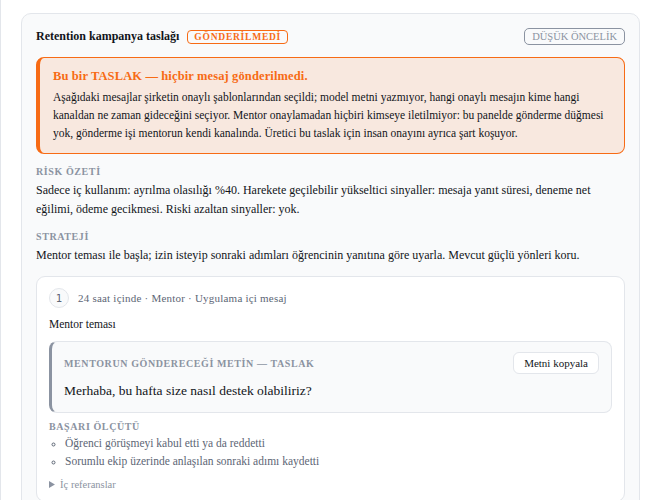
EO-Churn doesn’t send anyone a message. It ranks, gives the reason, and prepares the draft. The decision to send always stays with your team.
A calibrated dropout probability for every active student, ranked by risk. Not a binary “at risk / not at risk” label.
The top three reasons for each student, by column: “message reply time +0.18”, “mock-exam trend +0.17”.
An outreach draft picked from your own approved templates, with a success measure for the conversation.
The dashboard
Three views: the daily risk list, every student including those below the threshold, and model health: which threshold ran, how many rows were quarantined, when the last run happened.
How it works
No new data collection. EO-Churn reads what your systems already record.
A CSV or LMS export from the system you already use is enough.
Your headers are mapped to the system’s schema once, with a single mapping file.
The model learns from your own student history, not another institution’s. Unusable rows are set aside and reported to you.
Every active student is re-scored automatically each morning.
The ranked list, the reasons and the drafts land in front of your team.
The mentor reaches out and logs the outcome on the dashboard.
The outcome feeds the next training run, so the model adapts to your institution over time.
The model
Several candidate models are trained and measured on your data, and the one that performs best is selected.
On imbalanced data, the real question is “who do I call first?”. PR-AUC answers it; ROC-AUC alone misleads.
Raw scores are calibrated, so that “40%” really means 40%.
A false alarm and a missed dropout don’t cost the same. The threshold is set from that cost ratio and cut to your team’s capacity.
SHAP gives the top three reasons per student, by column name: “message reply time +0.18”.
Reliability
The rules that keep a backtest honest and a daily list usable.
At prediction time the model can’t see any data that didn’t exist yet. Without this, backtests look misleadingly good.
The system never just says “at risk”. It gives a calibrated percentage; your institution decides where to intervene.
If your team can hold twenty conversations a day, you get the twenty riskiest students. A list nobody can act on is no list at all.
Missing data isn’t filled in. The record is set aside and flagged; if too much is missing, no list is produced that day.
The model weights are handed over to you. The system keeps running even if our relationship ends.
Want to see it on your own data?
Request a free backtest ↗Delivery
Your team doesn’t need to log in. The list arrives every morning on the channels you choose: all three, one, or none.
The daily risk list with per-student reasons, to several recipients. Your own SMTP server can be used.
Instant notification to your team’s group or to one person. Your institution’s own bot, your own group.
Slack, Discord or your institution’s internal system: any endpoint that accepts a message.
Run time and time zone are configurable; the default is 09:00, Europe/Istanbul. Even on a UTC server, the mentor gets it at nine.
It can run on weekdays only, so a quiet Monday morning doesn’t look like an outage.
If no successful run happens within a set window, a separate operator channel is alerted. A silent system and a healthy one look the same from outside; this check tells them apart.
WhatsApp is on the roadmap: it requires the Business API, sender verification and approved message templates.
Dashboard & API
Every number on the dashboard comes from the system’s own API, and the same endpoints are open to you. They are protected with an API key and ship with an OpenAPI schema, so you can connect your CRM, student tracking system or reporting tool. We provide the dashboard; using it is up to you.
Outreach drafts
There is no send button on the dashboard. The responsible team reads, approves or edits the draft; the decision to send is always human.
Built on an open-weight model, not a closed service. It runs in your environment; no student data goes to a third party.
It works with your approved communication templates and your terminology, so the output speaks in your institution’s voice.
The three SHAP reasons are matched against your approved template library. The model picks which template fits whom and prepares the draft.
Data & security
We don’t ask for identity data; an anonymous student code is enough, and the key that links it to a student stays with you.
Data is sent encrypted, without name, surname, e-mail or national ID number. Only behavioural data and the student code are shared.
You share no real records. Column names and summary statistics (mean, minimum, maximum) are enough; we generate the dataset.
The system is installed on your server or cloud account; training and prediction run in your environment.
Free backtest
NO FEE · NO SETUP · NO COMMITMENT
EO-Churn
 Student dropout early warning© 2026 EOAI Lab